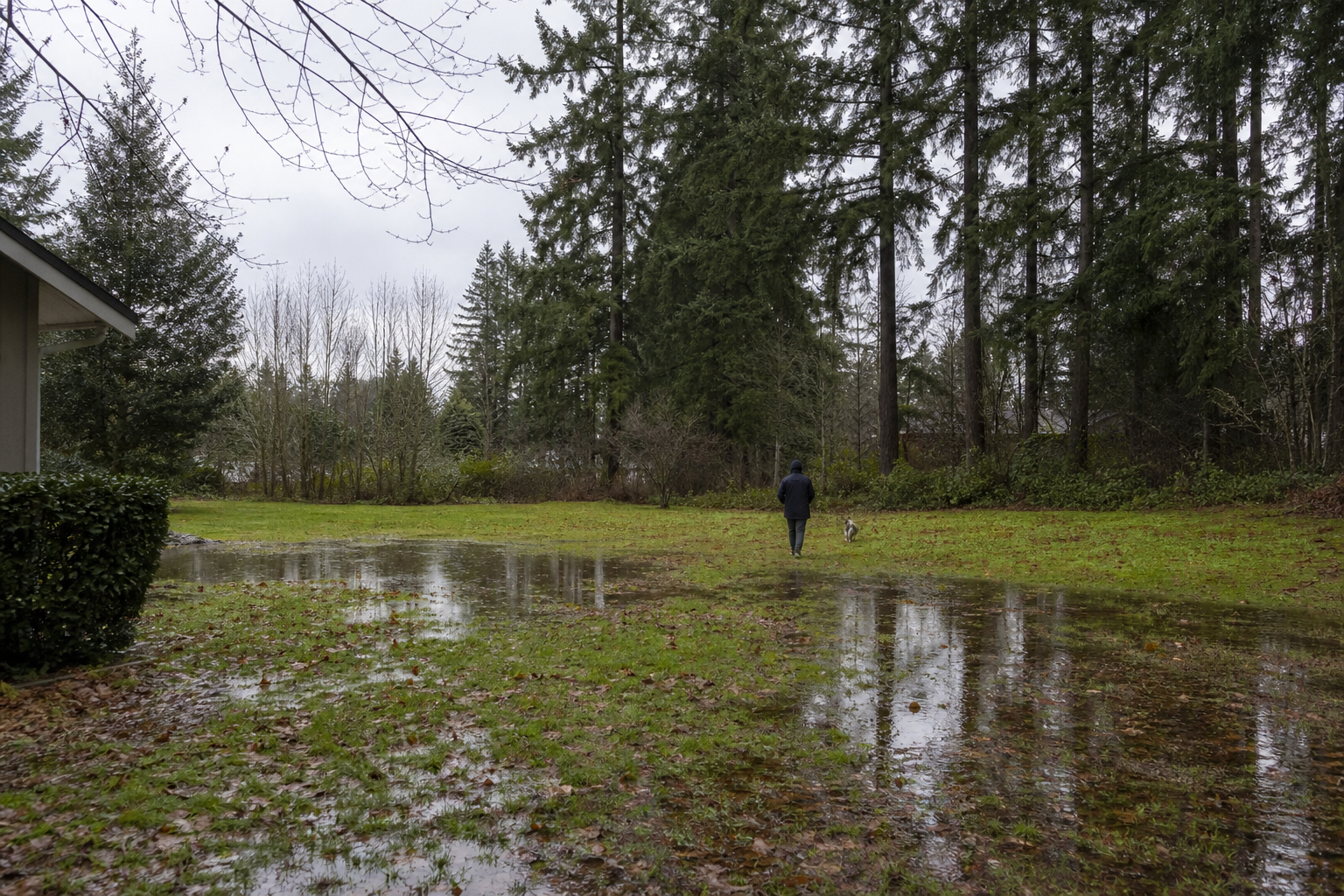
Standing Water After the First Fall Rains Near Olympia: Drainage or Septic?
The first serious rains arrive around Olympia and suddenly there is water standing in the yard that was not there in August. Sometimes it is a puddle in a low spot. Sometimes it is a soggy patch that never dries. Sometimes it is a wet area right over the drain field, and that is the one worth paying attention to quickly.
The question homeowners in Thurston, Mason, Pierce and Lewis counties ask us every fall is the same: is this just drainage, or is my septic system failing? The distinction matters enormously, because one is a landscaping and grading problem and the other is a public health problem with a much larger price tag.
Here is how to tell the difference.
Signs it is a drainage problem
Ordinary surface water behaves in predictable ways:
- It appears during and right after rain, and recedes when the rain stops — even if it takes a day or two
- It collects in obvious low points, at the bottom of slopes, along foundations, or where a downspout discharges
- It has no odor
- It is not concentrated over the septic tank or drain field
- It appears in the same places every year, and those places make sense given how the ground slopes
- Your fixtures inside behave normally — drains run at usual speed, toilets flush properly
This kind of water is a grading and drainage issue. Common causes are roof water dumped too close to the house, a driveway or patio that redirects flow, a culvert or ditch that has silted in, a compacted lawn that will not absorb, or simply a low area with nowhere to drain. The fixes are real construction — regrading, a French drain, a curtain drain, catch basins, culvert replacement — but they are contained problems.
Signs it is your septic system
Septic symptoms look different, and several of them are unmistakable:
Wet ground specifically over the drain field, especially if it stays wet when the rest of the yard has dried out.
Odor. A sewage smell outdoors near the tank or field is not a drainage problem. This is one of the clearest signals you will get.
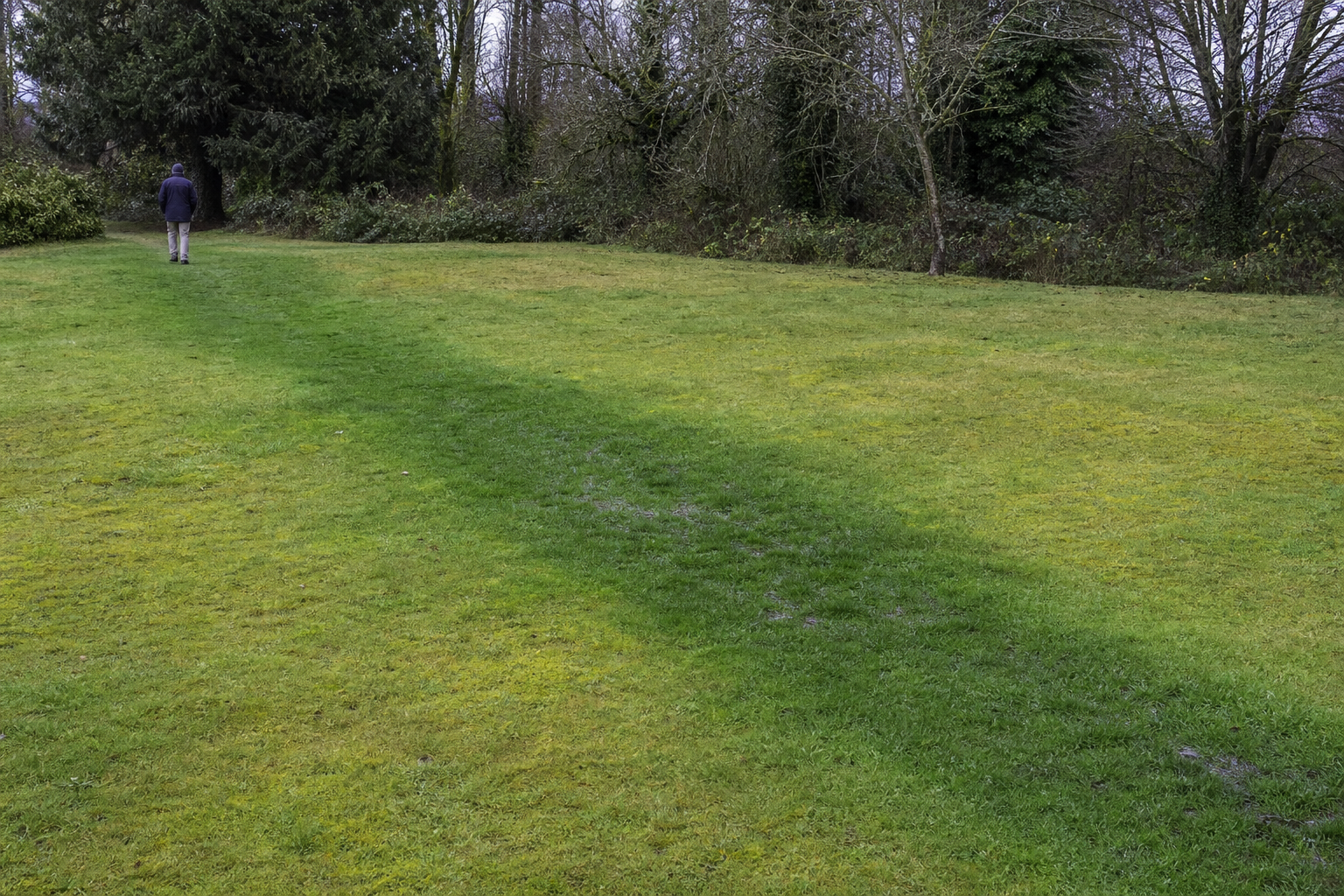
Unusually lush, dark green grass over the drain field. Effluent surfacing near the root zone fertilizes grass. A stripe of grass noticeably greener than the rest of the lawn is a classic sign.
Slow drains and gurgling throughout the house, particularly in the lowest fixtures. If several fixtures are slow at once, the problem is downstream of the house, not in one trap.
Backups in toilets or floor drains — especially if they worsen after heavy use, like laundry day or a full house.
Symptoms that track rainfall. If the system works acceptably in dry weather and struggles every time it rains hard, that points to a drain field that is saturated and has lost its capacity to accept effluent.
Standing water or ponding directly on the field surface. Effluent surfacing is a health hazard — keep people and pets away from it and get it evaluated.
The overlap, and why it is common here
Frustratingly, the two problems interact. Western Washington drain fields depend on unsaturated soil beneath them to treat and disperse effluent. When groundwater rises through the wet season, or when surface water is being routed toward the field, the soil beneath loses its capacity to take more.
A field that performs adequately in summer can be genuinely overwhelmed in December — not because the system is broken, but because the ground around it is saturated. That is why fixing the surface drainage is sometimes the actual solution: keeping roof water, driveway runoff and uphill flow away from the drain field can restore capacity.
It is also why a system that is marginal will show its true condition in the rainy season rather than in August.
What to check yourself this week
Follow your roof water. Where do your downspouts actually discharge? If any of them run toward the drain field, that is worth changing today.
Look at what is on the field. Vehicles, trailers, firewood stacks, a new shed, or livestock traffic all compact the soil over a drain field and damage it. Keep the area clear.
Check upslope flow. If ground above the field sheds water down onto it, an intercepting curtain drain may be the fix.
Note whether it is getting worse each year. A field that is progressively wetter every winter is telling you something.
Maintenance and the county's expectations
Thurston County requires ongoing operation and maintenance for onsite sewage systems, with inspection at least once every three years for systems consisting solely of a sewage tank and a gravity subsurface soil absorption system, and annually for other system types unless the health officer specifies otherwise. Systems with pumps, proprietary treatment products or disinfection fall into that annual category.
Beyond compliance, the practical value of a fall inspection is that it catches a marginal system before the wettest months rather than after a backup. If your tank has not been pumped in several years, and particularly if you have never had the system properly assessed, that is a sensible thing to do before the rainy season is fully underway.
When to stop guessing
Call someone if you have odor outdoors, sewage surfacing, backups in the house, or wet ground over the field that does not dry. Those are not wait-and-see symptoms.
If it is clearly surface water in a low spot with no odor and no plumbing symptoms, you are most likely looking at a drainage project — and fall, before the ground is fully saturated, is a reasonable time to address it.
South Bay Septic & Excavation is a family-owned company serving Thurston, Mason, Pierce and Lewis counties, including Olympia, Lacey, Tumwater, Shelton, Tacoma, Puyallup, Centralia and Chehalis, with septic inspections, installations, drain field replacement, French drains, drainage systems, grading and land clearing. If you are not sure which problem you have, describe what you are seeing here and we will help you sort it out.


