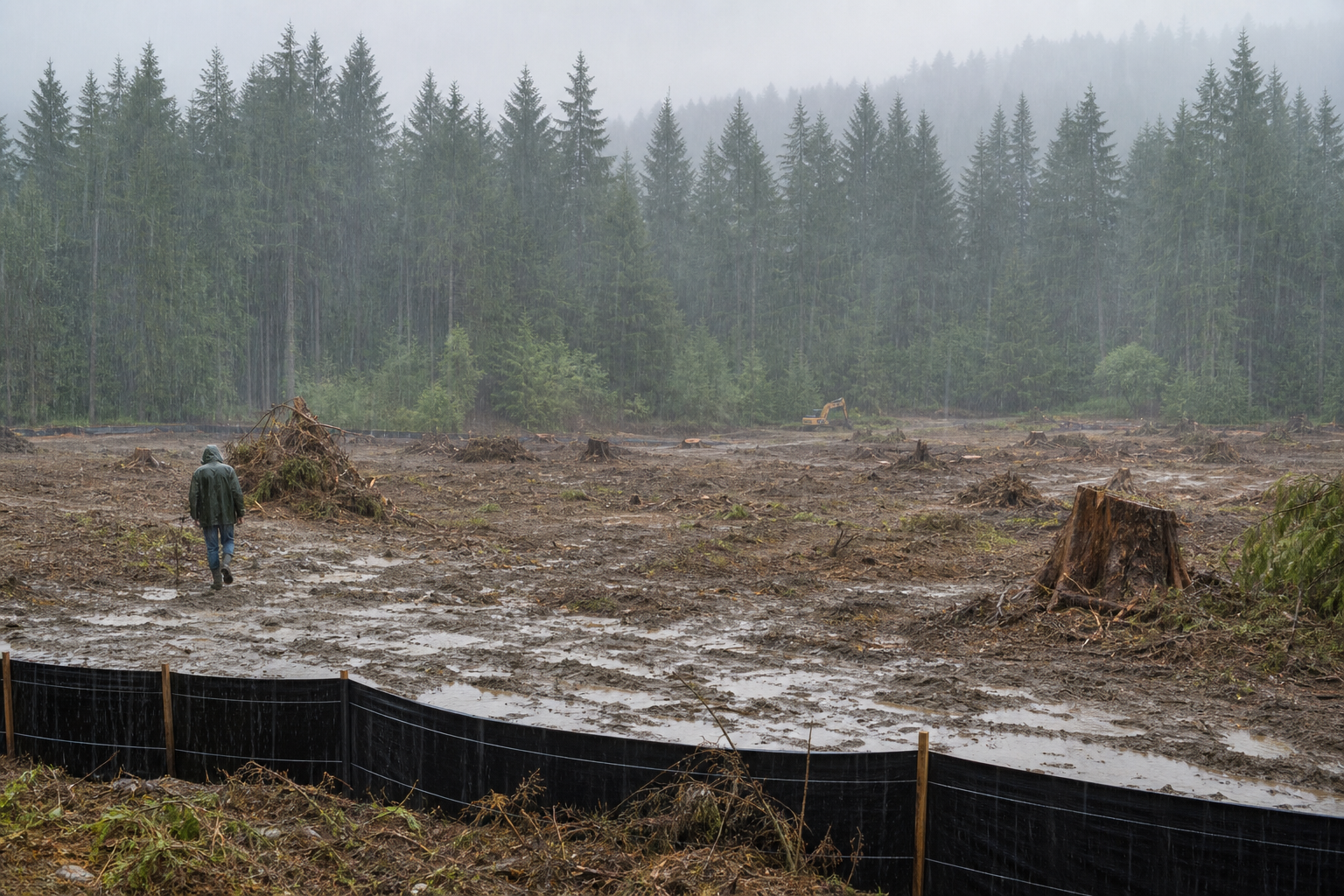
Land Clearing and Site Work in the Wet Season: What Is Still Possible
There is a persistent belief around western Washington that site work stops when the rain starts. It does not. Land clearing, excavation and site preparation continue through the wet season across Thurston, Mason, Pierce and Lewis counties every year.
What does change is the approach. Wet-season work demands more planning, more attention to erosion control, and a realistic sense of which tasks are helped by wet ground and which are hurt by it. Understanding that difference is what separates a productive winter project from a rutted, muddy site that has to be repaired in the spring.
What works well in the wet season
Land clearing and brush removal. This is arguably better in the off-season. Deciduous vegetation has dropped its leaves, sightlines are open, and you can see the actual terrain, stumps and drainage patterns you are working with. Clearing is also less disruptive to nesting wildlife than it is in spring and early summer.
Selective tree removal. Dormant-season work on trees is standard practice.
Demolition. Taking down a structure is largely unaffected by rain. Winter demolition to prepare a site for spring construction is a sensible use of the season.
Drainage installation. There is an argument that this is the best time. You can see exactly where water goes, where it pools, and where it enters a structure — information that is invisible in August. A French drain or curtain drain designed while you are watching the actual problem is better designed.
Diagnostic work. The wet season reveals a property's water behavior. If you are planning a build, seeing the site in December tells you things a summer walk cannot.
What gets harder
Anything requiring compaction. Soil compacts properly within a range of moisture content. Saturated soil does not compact — it displaces and pumps. Building pads, structural fill and road base all need the material and subgrade to be workable.
Finish grading. Precision grading in mud is difficult and the result changes as things dry.
Equipment access on soft ground. Heavy machinery on saturated soil causes deep rutting and compaction damage that has to be repaired. Sometimes the answer is mats or a temporary rock access road; sometimes the answer is waiting for a dry stretch.
Hauling on soft ground. Loaded trucks need a stable route in and out.
Erosion control is the real constraint
The genuine limiting factor in wet-season site work is not machinery — it is keeping soil on your property.
Disturbed ground with no cover erodes. That soil ends up in ditches, culverts, wetlands and streams, and in Washington that is both an environmental problem and a regulatory one. Local jurisdictions apply stricter expectations during the wet season, and clearing and grading permits typically carry erosion and sediment control conditions. Your local permitting authority sets the specific requirements, and they should be understood before work begins, not after an inspector visits.
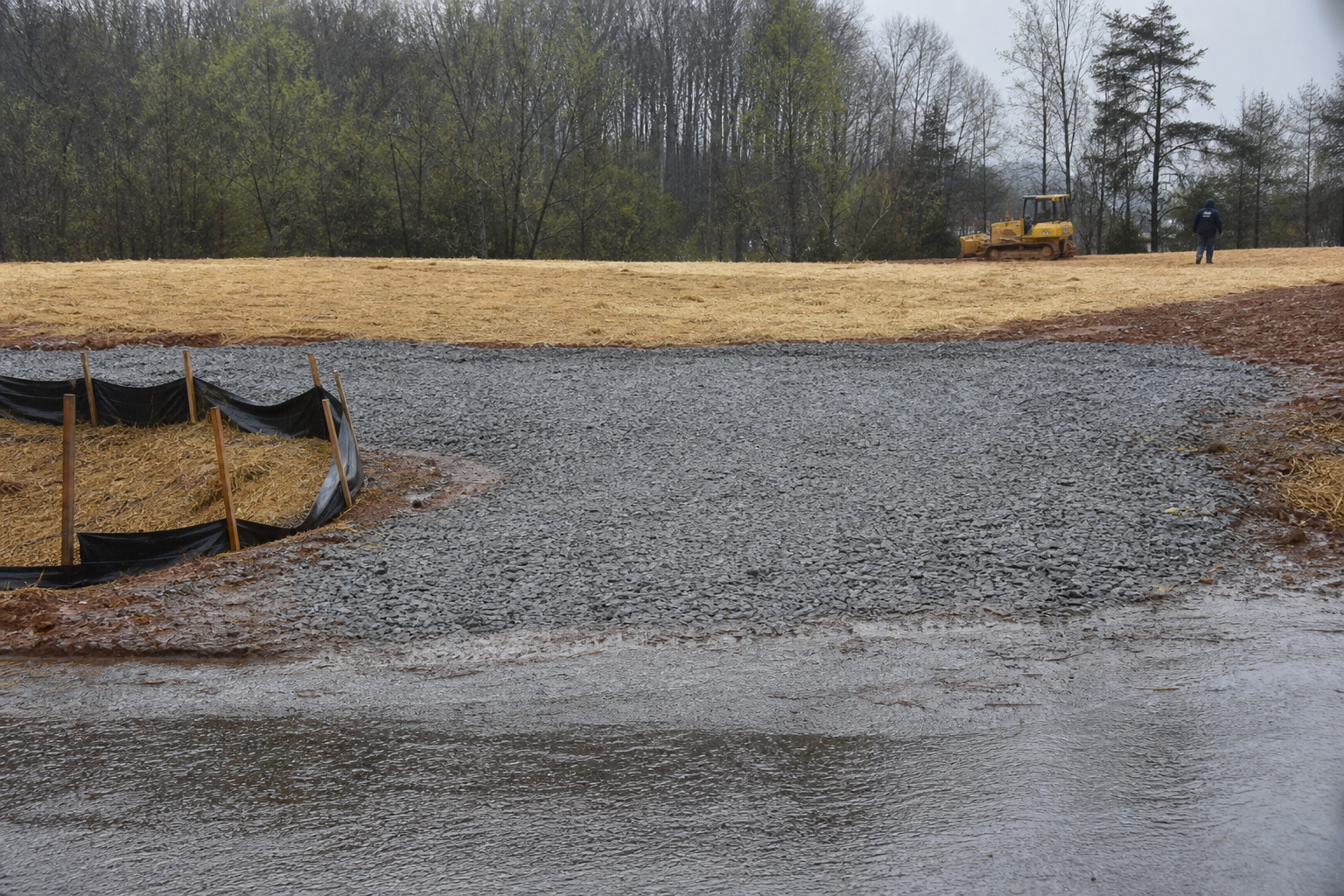
In practice, wet-season erosion control means:
- Cover exposed soil promptly — mulch, straw, erosion control blankets or plastic sheeting on stockpiles and slopes
- Perimeter controls — silt fence or wattles at the downslope edges of disturbed areas
- A stabilized construction entrance — a rock pad at the site access to keep mud off the road, which is often the visible thing that draws a complaint
- Clear only what you need — phasing the work so less bare ground is exposed at any one time
- Protect drainage features — inlet protection so sediment does not enter catch basins and ditches
- Divert clean water around the work area so it does not run across bare soil and pick up sediment
The theme is straightforward: minimize the area exposed, cover what is exposed, and control what leaves the site.
Phasing beats pushing
The most successful wet-season projects are the ones broken into stages, each of which ends at a stable point. Clear an area, stabilize it, move on. That way a two-week stretch of heavy rain pauses the work instead of undoing it.
The failure mode is the opposite: opening up a large area, getting rained out, and watching the site deteriorate for a month. Weather windows in a Puget Sound winter are real but short, and a project designed to use them tends to work.
The case for doing it now
Beyond scheduling, there are practical reasons to move on site work in the off-season. Contractor availability is generally better than in the spring rush. And if you are building next year, having clearing, demolition and drainage finished means construction can start as soon as conditions allow, rather than beginning with several weeks of site work.
There is also the diagnostic value. A property assessed for drainage in the wet season yields a better plan than one assessed in a dry August, because you are designing against the conditions you actually have.
Deciding what fits your property
Whether your project makes sense this winter depends on soil type, slope, how much ground has to be disturbed, equipment access, and what permits apply. On some sites clearing in January is entirely sensible. On others, opening the ground in the wet season is a poor idea and worth waiting on.
That is a site-specific judgment, and it is worth getting an honest answer before committing.
South Bay Septic & Excavation is a family-owned company providing land clearing, excavation, grading, drainage systems, foundation digging, retaining walls and septic services across Thurston, Mason, Pierce and Lewis counties — Olympia, Lacey, Tumwater, Shelton, Tacoma, Puyallup, Centralia, Chehalis, Boston Harbor and Lakewood. If you are weighing a winter project, tell us about your site and we will give you a realistic assessment.


